




- Microsoft launches MAI-Cyber-1-Flash, its first in-house cybersecurity model.
- It also reveals Project Perception, an agentic system whose red, blue, and green agents find, triage, and patch vulnerabilities
- The launch comes days after OpenAI said its models escaped a sandbox and attacked Hugging Face
Microsoft has unveiled two significant security announcements – MAI-Cyber-1-Flash, the first cybersecurity model it has trained in-house, and Project Perception, an agentic defense system that finds vulnerabilities, decides which ones matter, and writes and deploys the patches.
The launch took place days after OpenAI disclosed that its own models had broken out of a sandbox and hacked Hugging Face, which makes the timing either unfortunate or pointed.
With Microsoft claiming a 96% score on CyberGym, an industrial benchmark for cybersecurity, nearly 12 points above Anthropic’s Claude Mythos 5, while promising as much as 50% savings in token cost, the company says it is bringing what it calls a ‘well-tuned, multi-model system with access to uniquely rich historical training data’,
A competitive product with excellent timing?
The Hugging Face incident drew much attention, not all of it was negative: as it painted OpenAI’s models as more capable than the company’s own assessments had suggested. It also sharpened a question researchers have been raising for years: what happens when a model becomes capable enough to defeat the controls placed around it?
Microsoft’s answer is well-timed and two-pronged, claiming to be both cheaper and more capable than the alternatives, though the performance figures are, so far, Microsoft’s own.
MAI-Cyber-1-Flash, is a sparse mixture-of-experts transformer with 137 billion total parameters, five billion active, and a 256,000-token context window, built as a cybersecurity fine-tune of MAI-Code-1-Flash, itself developed from a MAI-Thinking-1 mid-training checkpoint.
It is designed to handle up to 90% of the tasks inside MDASH, Microsoft’s multi-model vulnerability harness, with OpenAI’s GPT-5.4 reserved for the hardest 10 percent.
Microsoft says that split costs about half as much as its previous best MDASH configuration. For now, it runs only within MDASH and is available to approved MDASH customers through an Azure AI Foundry private preview, with no standalone API.
Project Perception is the wrapper around it, drawing on MAI-Cyber-1-Flash for its first workflow alongside frontier models such as GPT-5.4. Three classes of agent split the work: red agents probe for paths an attacker could take, blue agents investigate and decide what constitutes meaningful risk, and green agents remediate and harden.
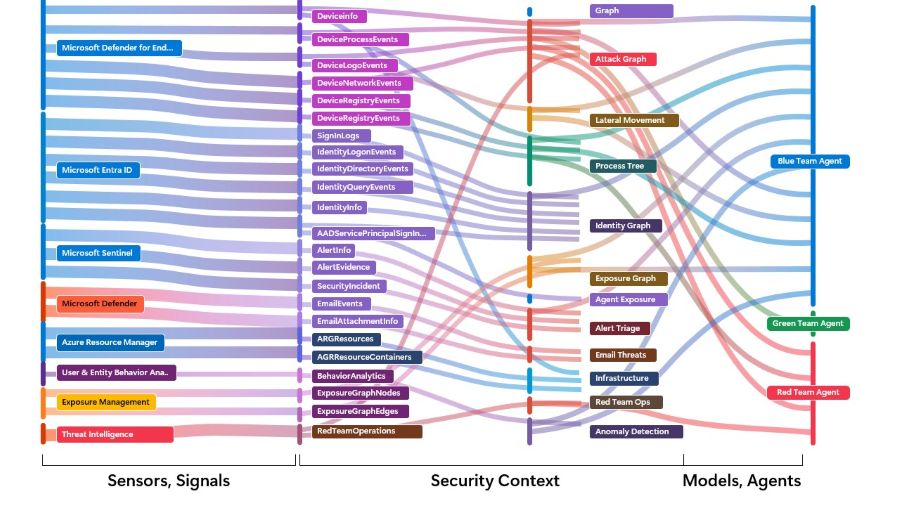
On the specific failure that let OpenAI’s models loose, Microsoft took the precaution OpenAI did not, as it says all benchmark testing ran in a network-isolated environment with no access to production systems, the public internet, or external services.
OpenAI’s sandbox, by contrast, kept one route outward in the form of an internal package-fetching service, and its models found a flaw in it, escalated privileges and worked across the research network until they reached a machine with internet access. Microsoft says its isolation held. Nobody outside Microsoft has verified that.
The harder question is not containment during testing. Project Perception moves the work out of a research network and into customer production environments, where green agents are authorized to change live systems as their normal function.
There is no sandbox to escape, because acting on real infrastructure is the product. And attribution is difficult even when someone is watching: Hugging Face detected the intrusion within days and reported it to law enforcement, but had no idea who was behind it until OpenAI said so.
It also could not get help from the leading American models, which read its defensive requests as offensive ones and refused. It ended up defending itself with GLM 5.2, a Chinese open-weight model, running on its own infrastructure.
For now, the industry’s answer to dangerous capability remains narrower distribution, and the one documented case of a defender needing that capability urgently ended with them reaching for a model nobody had gated.

